
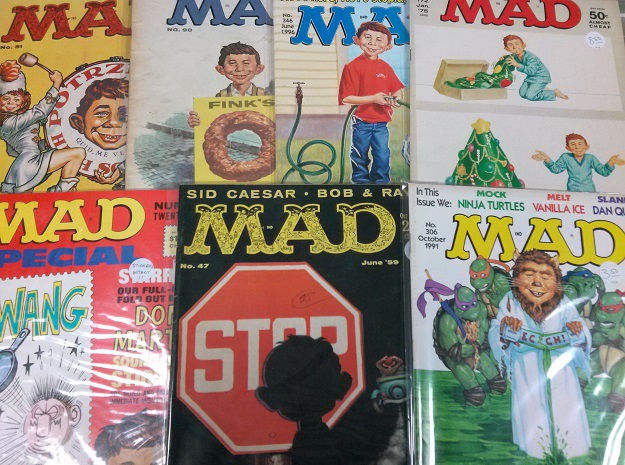
You demanded them, I finally got ’em…a new selection of Mad Magazines, dating from the ’60s to the ’00s, including some extra-sized specials! Also mixed into the batch are issues of Cracked and Crazy! If you’re in need of a laugh, Sterling Silver Comics is the place to go! …Wait, maybe I should phrase that differently…!
Author Archives: Mike
More old comics in stock!
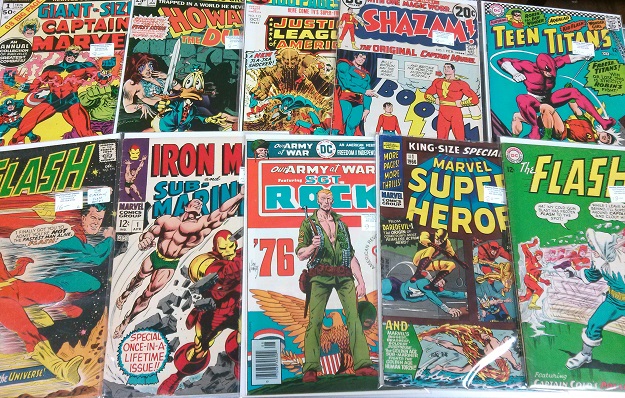
Just acquired: lots of Justice League of America and Flash from the ’60s and ’70s, the 1970s Shazam! run, some war books, some horror comics, a lot of the original Marvel Graphic Novels from the ’80s, a whole bunch of ’70s Marvel magazines, and more! Drop by the shop and check out what we’ve got in!
Back Issue of the Week: Flaming Carrot Comics #31 (October 1994).
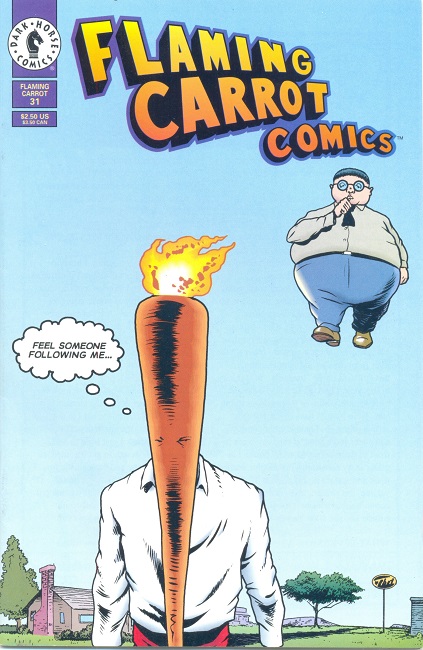
A team-up for the ages! The Flaming Carrot, the oddball surreal superhero, joining forces with Herbie Popnecker, the star of an equally-strange comic book series from the 1960s! If I recall correctly, Carrot creator Bob Burden had actually sought out Herbie’s creator, Ogden Whitney, for an artistic collaboration but Mr. Whitney had unfortunately passed away in the 1970s. Burden is more than up to the task of presenting the inherent weirdness of Herbie, however. FUN MIKE FACT: the Flaming Carrot’s secret identity is a long-standing mystery, and I was half-convinced that the Flaming Carrot was, in fact, a grown-up Herbie. One would think this particular issue would have put that theory to rest, but frankly, given the sorts of adventures both characters were involved in, that still isn’t a deal-breaker!
Back Issue of the Week: The Joker #6 (March/April 1976).
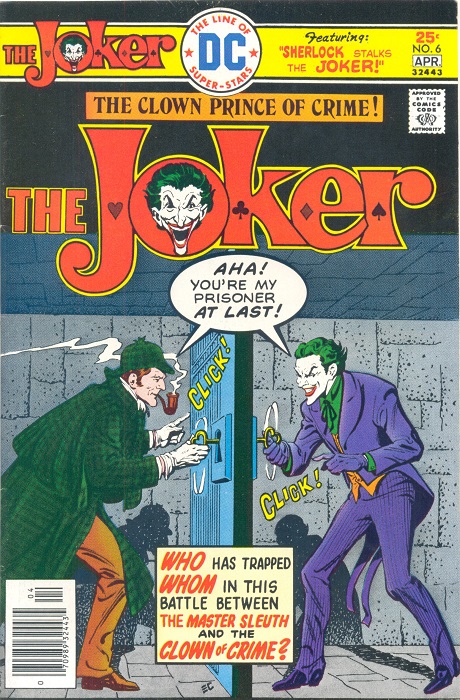
A classic example of the “villain as hero” comic book series, The Joker had a short but memorable run in the 1970s. Because he was the villain, despite being the star of the book he usually met with a Comics Code Authority-mandated defeat at the end of each issue. However, plenty of guest-stars, heroes and villains, popped up in the comic, including Superman’s nemesis Lex Luthor, the Creeper, Catwoman, and, as in the issue pictured above, Sherlock Holmes! Okay, in the story it was an actor playing Sherlock Holmes, but close enough! An oddball classic by Denny O’Neil, Irv Novick and Tex Blaisdell!
Local Comic Shop Day at Sterling Silver Comics on Saturday, November 19th!
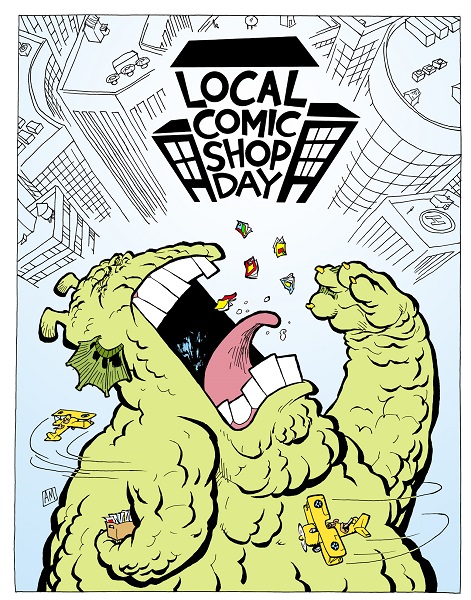
Saturday, November 19th is Local Comic Shop Day at Sterling Silver Comics, and we’ll have an assortment of limited edition graphic novels, statues, and variant covered comics from DC Comics, Marvel, Black Mask, Boom!, Image, and more, while supplies last! We’ll also have special in-store deals for that day! Hope to see you there!
Today is the second anniversary of Sterling Silver Comics!
Thanks to all of you out there for your ongoing patronage and support, and making my store the success that it is! I am extremely grateful.
Now onward to our third year (and hopefully more besides)!
Back Issue of the Week: Welcome Back, Kotter #4 (May 1977).
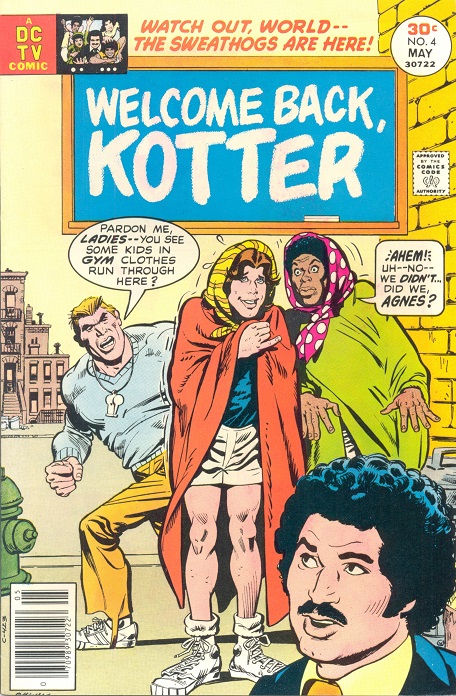
This issue from DC Comics’ short-lived adaptation of the popular 1970s sitcom, illustrated by Ric Estrada and Bob Oksner, was written by Mark Evanier, now known for his collaboration with Sergio Aragones on Groo the Wanderer and his work on various iterations of the Garfield cartoon. However, he had also worked on the actual Welcome Back, Kotter TV show as an editor and writer, making him quite ideal for this particular assignment!
Back Issue of the Week: Silver Surfer #34 (February 1990).

The modern era of Thanos begins in 1990’s Silver Surfer #34, returning after his seeming death in the late 1970s (and a cameo appearance here and there). And he’s hardly left after that, starring in multiple event series (such as Infinity Gauntlet and its several follow-ups), and showing up everywhere from Ka-Zar to Guardians of the Galaxy to even the Marvel live-action movies ever since reappearing in that comic pictured above. Not too bad for a dead guy! Thanos will be featured in a new ongoing monthly series due out in November, so clearly he’s not going away again any time soon!
Steve Dillon (1962 – 2016).
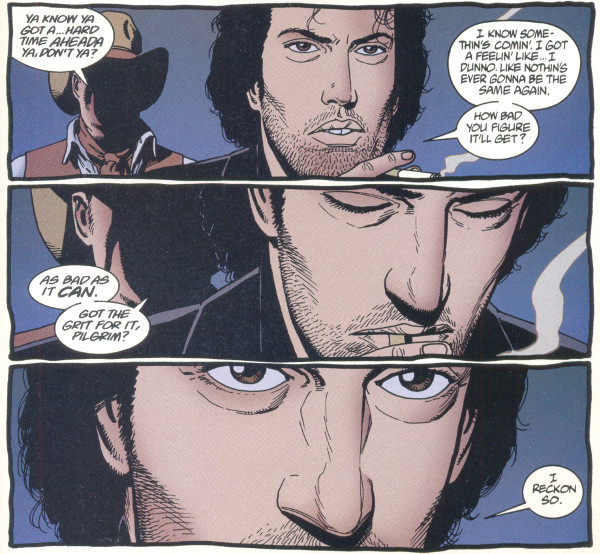
Steve Dillon, cocreator and artist of Preacher, and artist for highly regarded runs on Hellblazer and Punisher, has passed away at the far-too-young age of 54. He was one of the greats, with a deceptively clean style that carried a wide range of emotion. Condolences to his family, friends, and fans.
image from Preacher #34 (February 1998), written by Garth Ennis and illustrated by Steve Dillon
Back Issue of the Week: Superman: Speeding Bullets (1993).
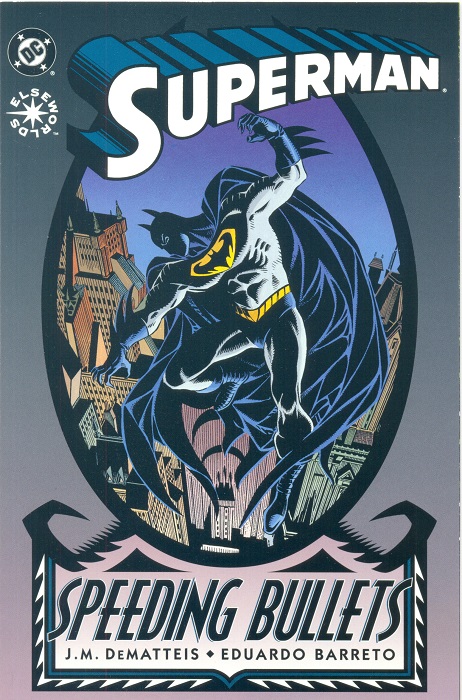
There’s been a long history in Marvel and DC’s comics of stories outside the regular continuity of their superhero comics, in which either minor changes to characters and situations (“What If Spider-Man Joined the Fantastic Four?”) or more drastic alterations (“What If Superman and Lex Luthor Were Brothers?”) were explored. These were called (as may come as no surprise) “What If” stories by Marvel, and “Just Imagine” or (mostly) “imaginary stories” by DC, though DC would adopt the “Elseworlds” label in later years.
One of the most famous (well, next to Kingdom Come) of DC’s Elseworlds is Superman: Speeding Bullets, in which the infant Kal-El is rocketed to Earth and, instead of being found the Kents in Smallville, is instead adopted by the Waynes in Gotham City. Effectively, it’s “what if Superman became Batman,” with even Lex Luthor becoming a variation of one of Batman’s most famous villains over the course of the story. In a way, Speeding Bullets is an updating of the “Bruce (Superman) Wayne” stories that ran in the 1980s…a similar set-up (Kal-El raised by the Waynes) only actually becoming Superman from the get-go. (You can see a cover blurb for those stories on this cover).
Nowadays, DC has mostly avoided doing new Elseworlds stories in favor of trying to establish the main continuities for their characters, but has been in the process of bringing them back into print (such as the recent Elseworlds: Batman trade paperbacks). Fun stuff, and individual Elseworlds specials are still pretty easy to find in the back issue bins.